
UNIFIED ASSETS
The foundational records your charter execution runs on
Every time charter contracts exist in a wider context of vessels, operations and counter parties. To manage your Time Charter business effectively you need a single source of truth for your vessels, ports, counter parties and the commercial structure behind them.
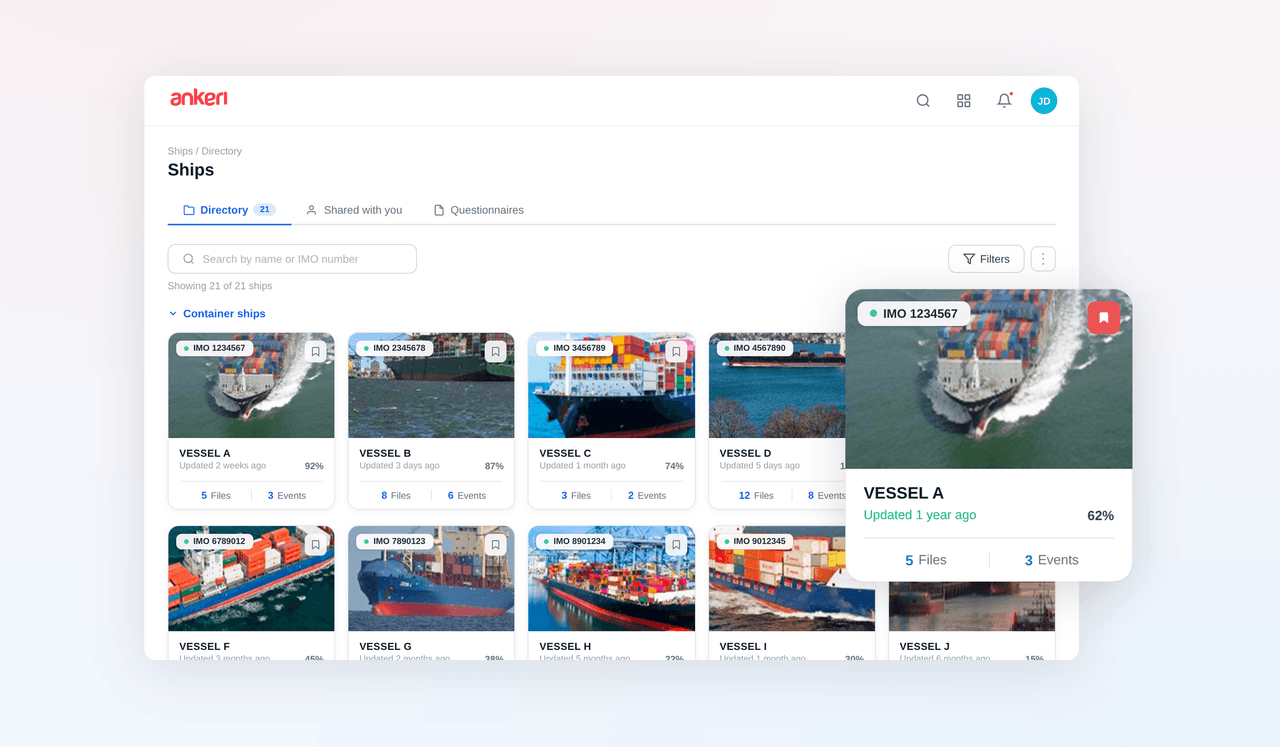
See how 2,000+ ship profiles are managed
THE FOUNDATION
Every module in Ankeri starts here
Ankeri structures this context once and applies it across the entire charter lifecycle. Vessel records, terminal specifications and counterparty relationships become a consistent foundation for contract terms, operational events, emissions exposure and reconciliation workflows. With a stable baseline in place, teams gain clearer traceability across execution and smoother coordination across workflows.
Search, filter, and manage your entire fleet from one place
Plausibility checks compare each profile against sister and similar vessels
Share ship profiles with external counterparties on your terms
Export vessel data into any mapped questionnaire format automatically
HOW IT WORKS
Vessel records, terminal specifications, and counterparty relationships, structured once, reused everywhere
Ships
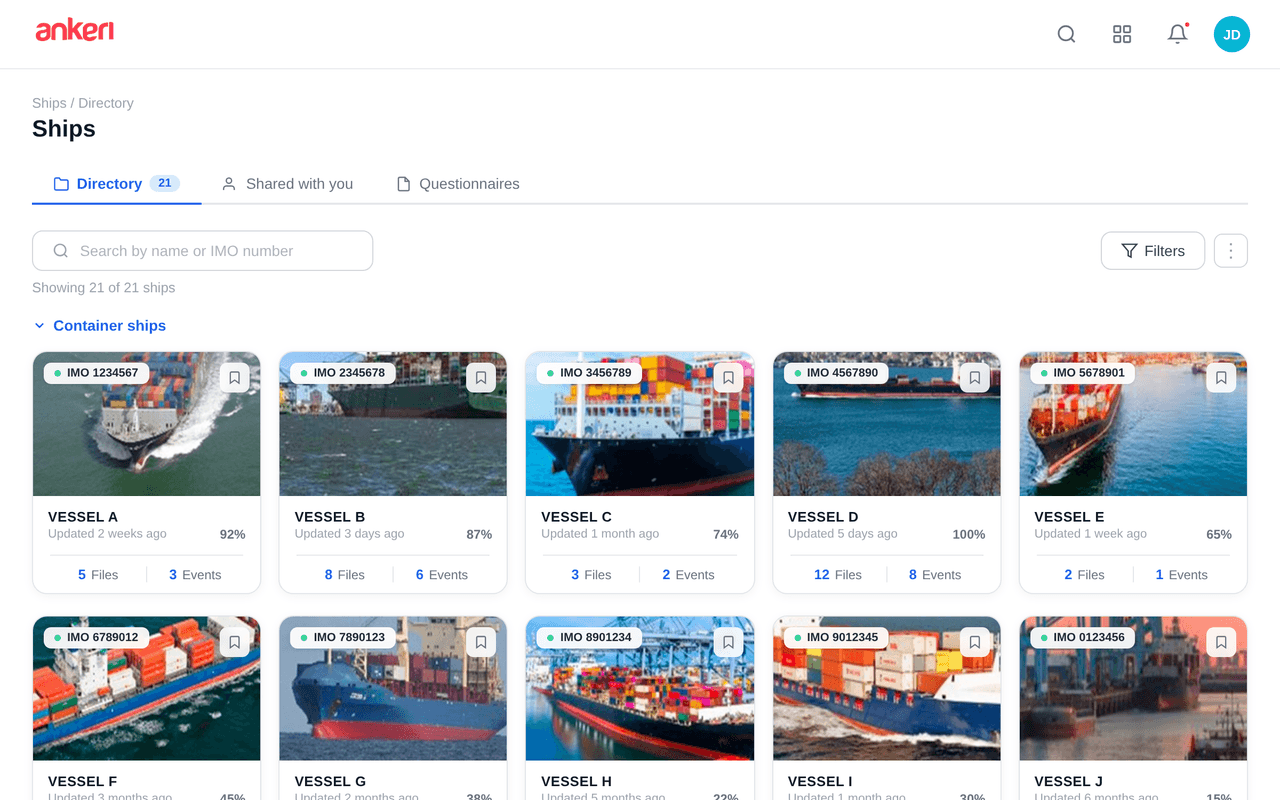
Ships act as the central repository for all vessel-related information, ensuring that specifications, documents, and operational events are consistently structured and easily accessible. This allows teams to maintain a complete and up-to-date view of each vessel, with support for data validation, version tracking, and seamless sharing across internal and external stakeholders. In addition, the module streamlines workflows such as charter questionnaires by enabling structured data exchange and automated exports in required formats, including Time Charter Descriptions. By centralising ship data and standardising how it is managed and shared, Ankeri reduces manual effort, improves data quality, and ensures that vessel information is always ready to support chartering, operations, and compliance processes.
Terminals
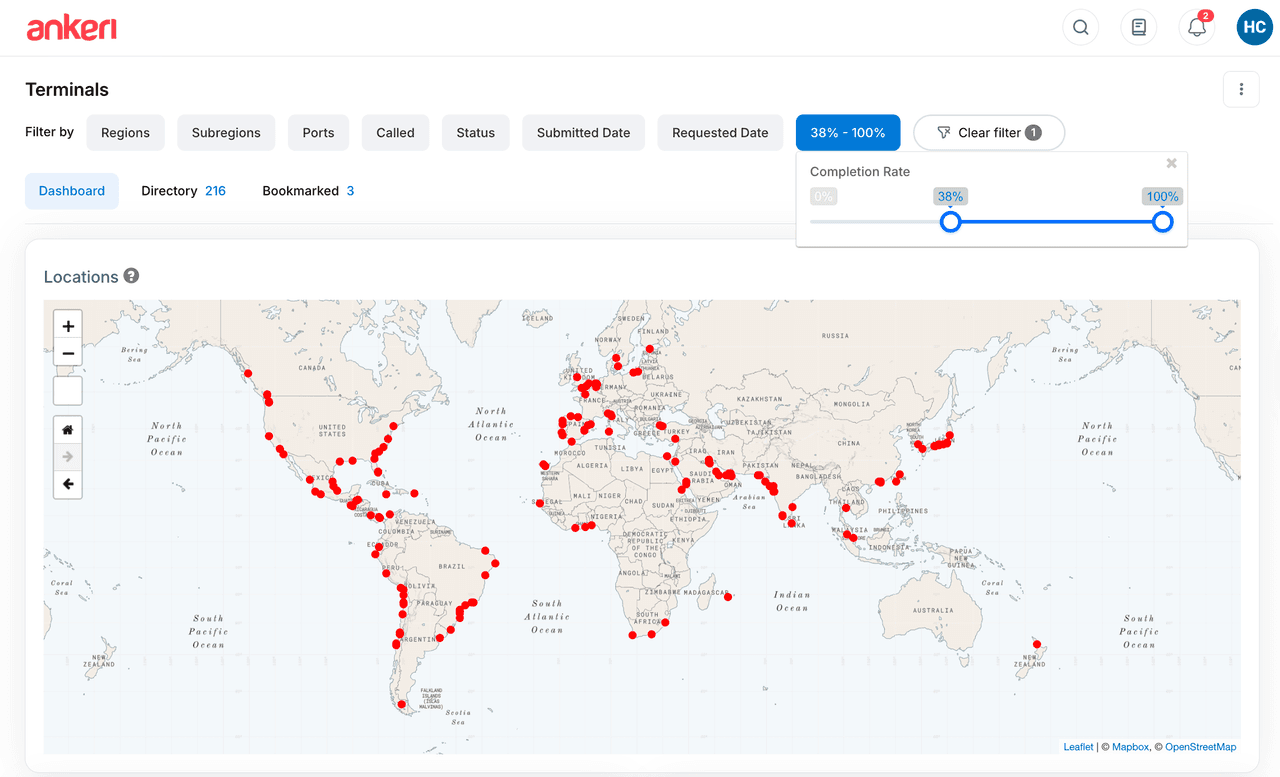
The Terminals module provides a structured repository for port terminal data, enabling you to capture and maintain detailed specifications such as approach, berths, cranes, and other operational parameters. It also allows you to track agreed terminal KPIs, giving you a clearer understanding of performance expectations alongside physical capabilities. The module facilitates collaboration with external parties by allowing you to share terminal specifications and request updates directly, ensuring data remains accurate and up to date. With features such as completion tracking, document management, KPI visibility, and side-by-side comparison of terminals, your team gains a reliable and comprehensive overview of terminal capabilities and performance across your network.
Companies
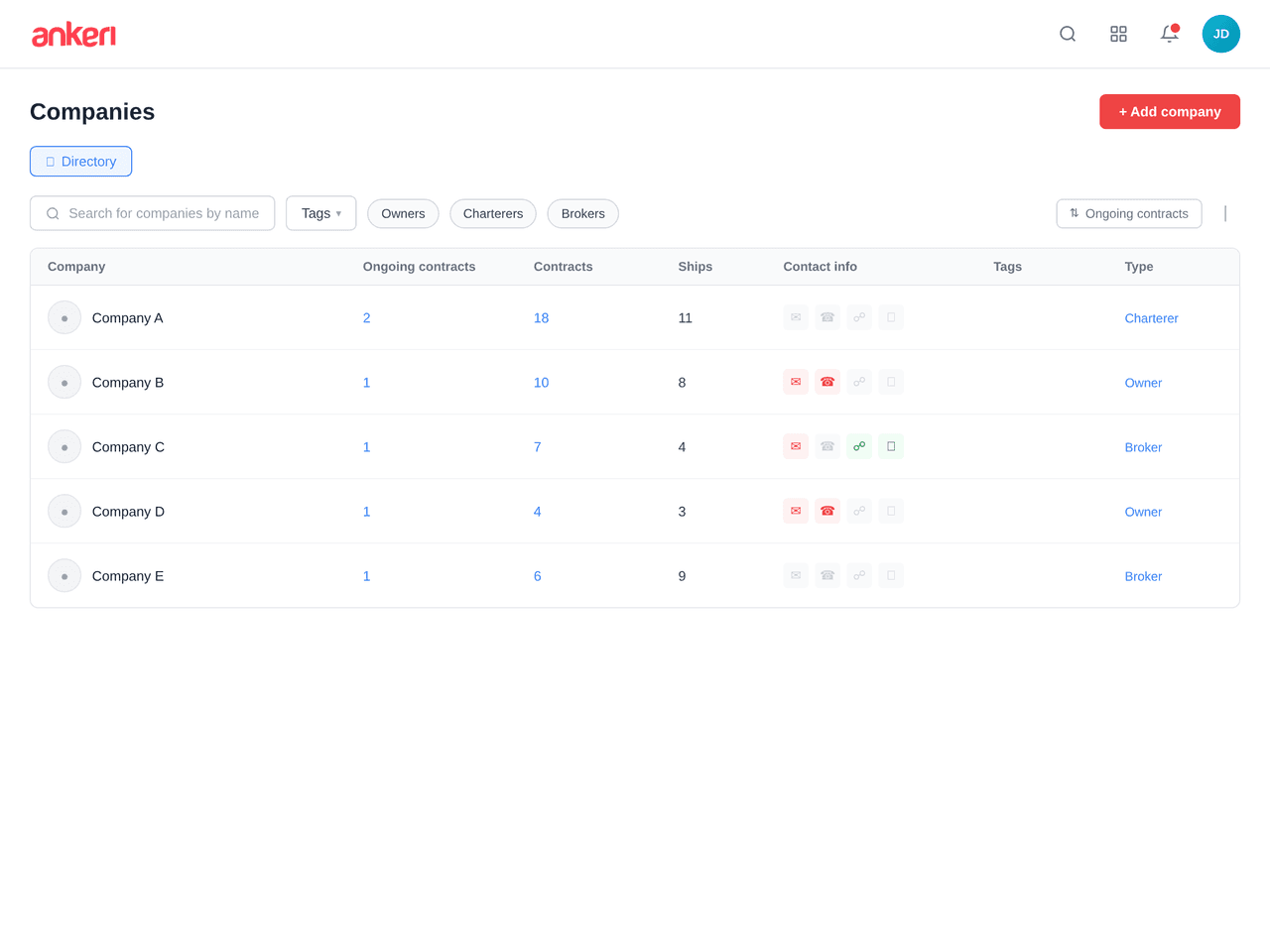
The Companies module provides a structured overview of all owners, charterers, and brokers within your Ankeri environment. By centralising counterparty data, it gives you clear visibility into your commercial relationships, including contract activity and fleet exposure across each company. You can easily browse, filter, and organise companies based on key metrics such as number of contracts, ongoing engagements, and associated vessels. This enables your team to maintain an up-to-date view of counterparties, supporting better coordination, transparency, and decision-making across your chartering operations.
Services
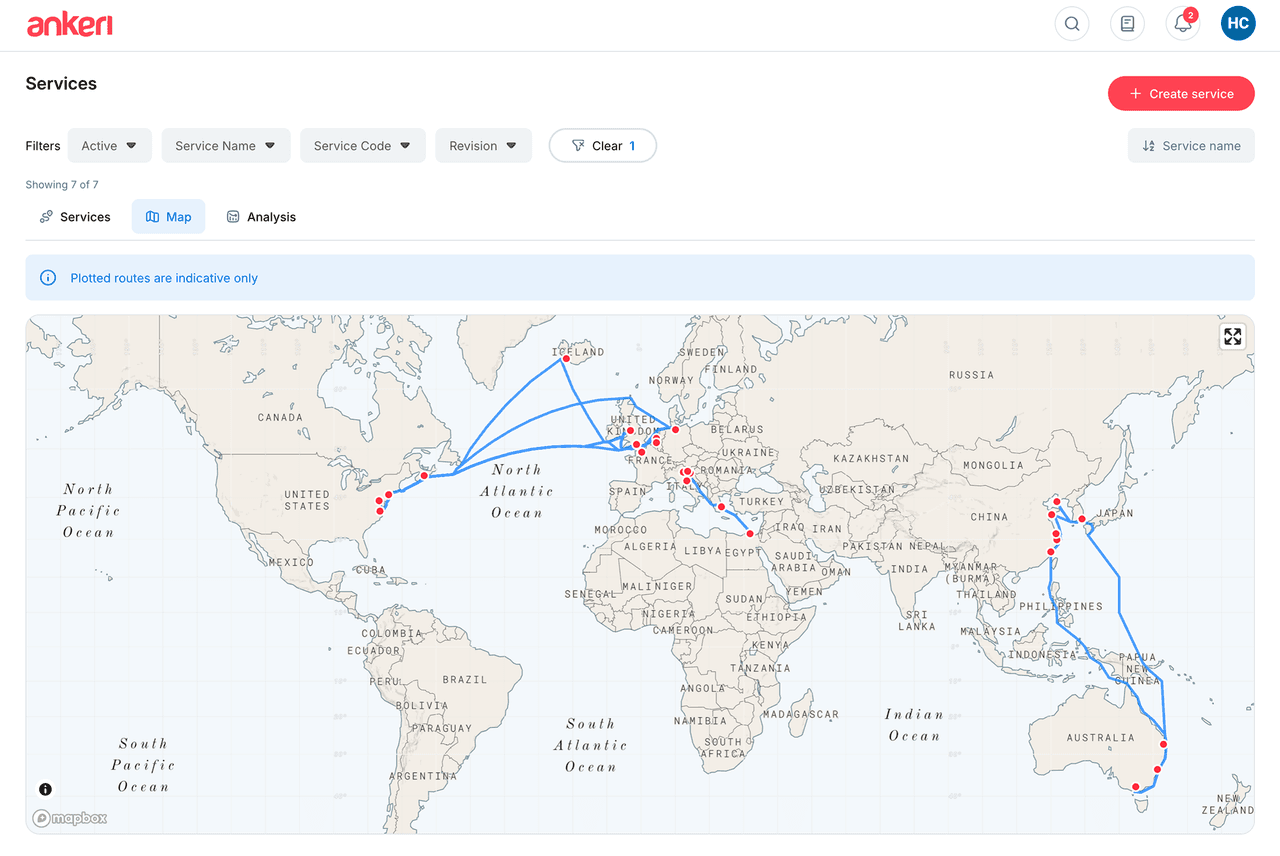
The Services module allows you to define and manage your trade services by structuring routes, terminals, and key operational parameters such as cargo volumes, sailing speeds, and distances. By capturing services as structured data, you create a consistent framework for planning and analysing fleet deployment across different trades. You can view and manage services in both list and map formats, compare planned service parameters with actual operational performance, and adjust configurations as needed. Services can also be leveraged in simulation tools such as CII Simulation and Fleet Transition, enabling you to model different deployment scenarios and assess their impact on performance and compliance. This ensures that service planning is not only aligned with current operations but also supports forward-looking decision-making.
What Our Clients Say
Ankeri has eliminated the need for these disparate tools. Now, Ernst Russ consolidates various data streams - ship profiles, contract details, performance metrics, and semi-automated invoicing - into one consistent user experience. Consequently, collaboration across departments at Ernst Russ has strengthened, making our workflow more transparent and efficient.


CONNECTED PILLARS
Unified Assets powers everything else
AI-powered execution that draws on your validated vessel, terminal, and counterparty data
Charter execution and emissions compliance running on your validated fleet data
Take control of your maritime data stack
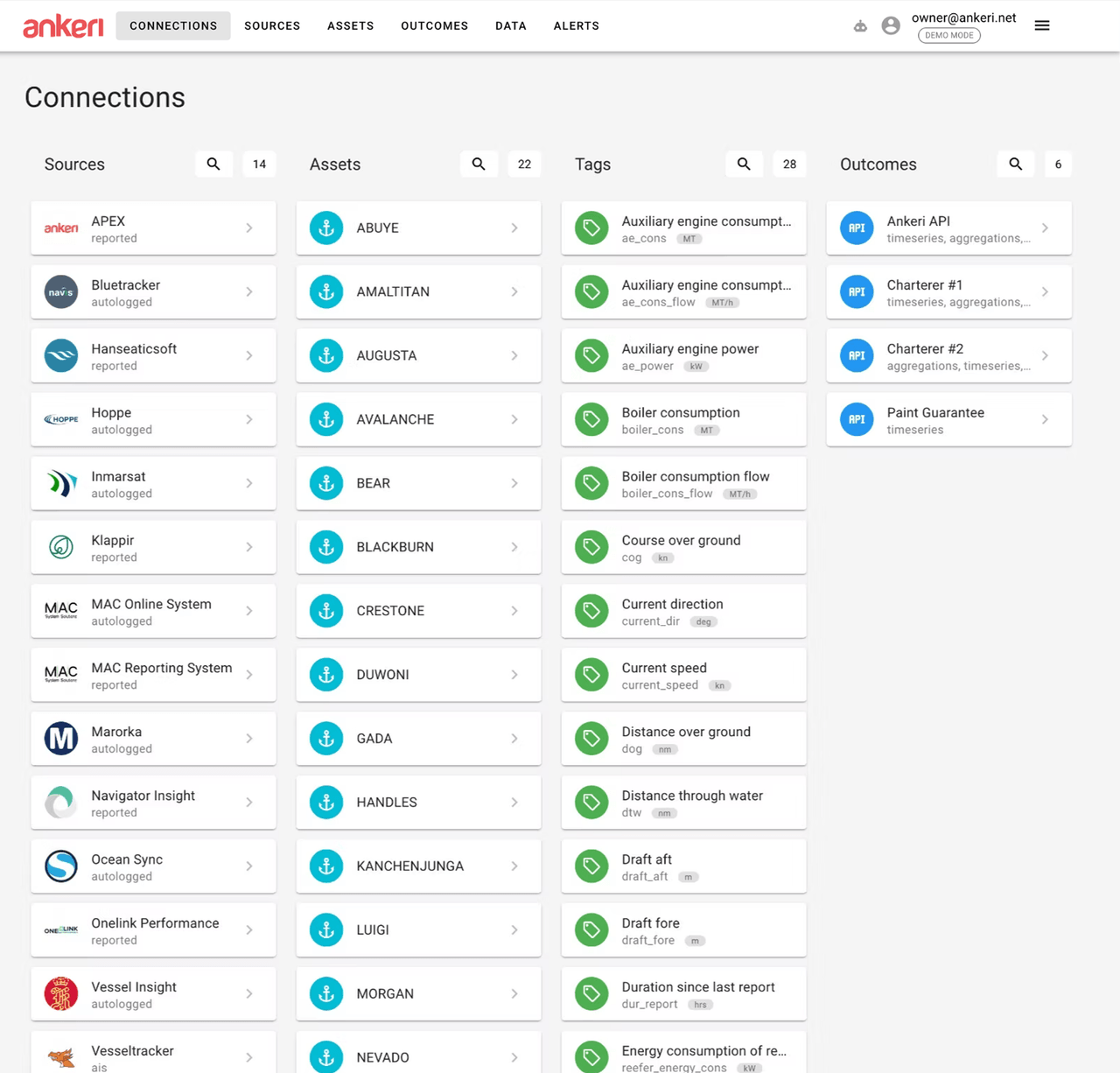
Ankeri Data Connections Hub™ (DCH) is a scalable, cloud-based data platform that transforms ships’ time-series data into AI-ready, structured information securely accessible to both internal and external stakeholders. By standardising and unifying data across sources, DCH ensures consistency, reliability, and seamless integration across your operations.
DCH simplifies complex data engineering tasks by structuring vessel data into a uniform model, available through secure integration APIs and an MCP-enabled layer. This enables effortless, controlled data sharing across your organisation and partners, while maintaining full governance. With the integrated AI agent, you can go beyond access leveraging your data to surface insights, support decisions and enhance operational performance.
Explore our capabilities further
Ankeri unifies your digital assets and as a single source of truth in a shared foundation across the Ankeri platform. The same vessel, terminal, and counterparty records are used in other connected pillars such as Live Operations, feed into Future Strategy, and stay visible in Collective Intelligence ensuring that the charter lifecycle remains connected from fleet planning and during pre and post fixture workflows.
Explore our capabilities further to see how Ankeri connects execution, exposure, and outcomes in one system.