
AI at Ankeri: From Data Fragmentation to Operational Intelligence
Artificial intelligence is transforming software across every industry. Shipping is no exception. At Ankeri, we believe AI should not be a layer on top of systems; it should be embedded in the operational fabric of how maritime organisations work.
Since we started Ankeri nearly 10 years ago, our focus has been clear: bring together fragmented maritime workflows and data across chartering, invoicing, and vessel operations. We’ve always believed that true value comes from connecting commercial and technical realities, not treating them as separate systems.
Today, we are taking the next step.
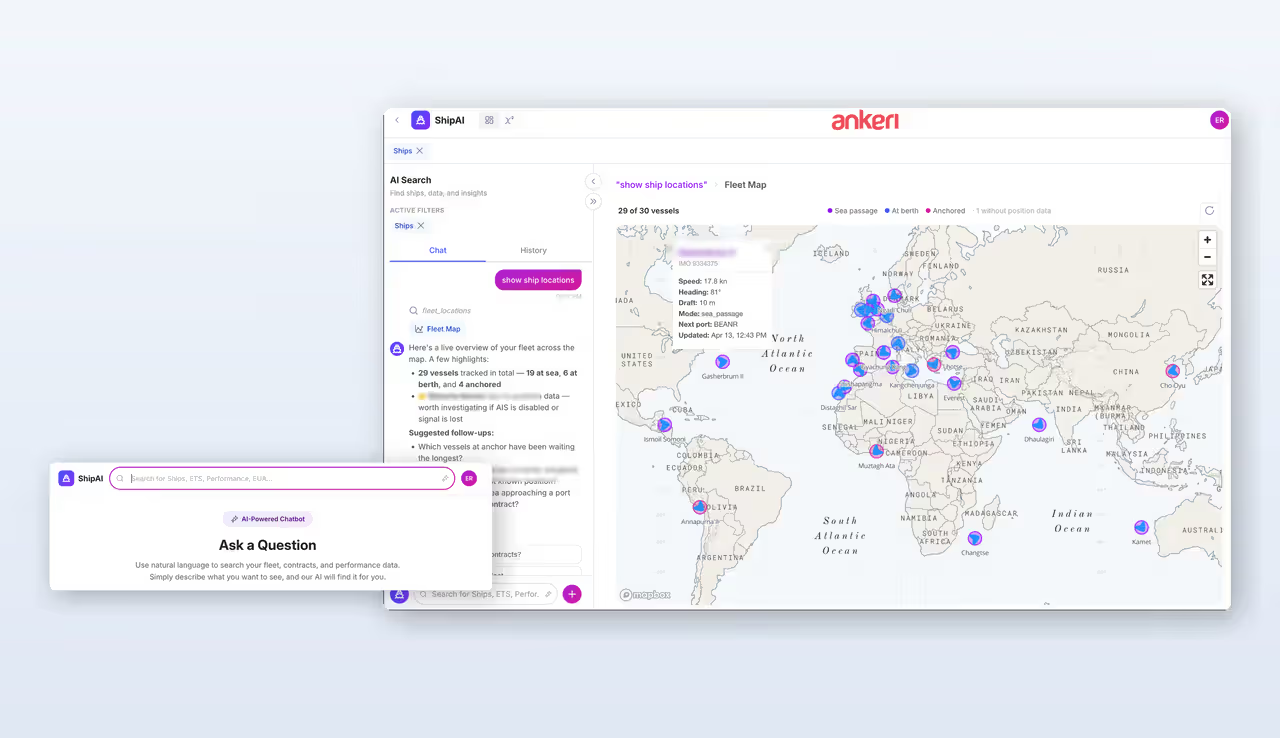
Ankeri now includes a built-in AI Agent, allowing users to interact directly with their operational data through natural language. At the same time, Ankeri exposes MCP (Model Context Protocol) servers, enabling secure and structured access for external AI systems.
AI Is Only as Valuable as the Context It Understands
AI on its own is not the breakthrough. Context is.
In most maritime organisations, critical data is still fragmented:
- Chartering contracts
- Chartering Invoices and financial flows
- Emissions (EU ETS, FuelEU, CII)
- Vessel and terminal specifications
- Counterparty agreements
Individually, these systems provide partial answers. Together, they define the reality of operations.
Ankeri’s core role is to unify this context. With the introduction of the AI Agent, Ankeri platform users can now:
- Ask questions across chartering, operations, and compliance
- Retrieve contract-specific insights instantly
- Understand financial and emissions implications in context
- Navigate complex workflows without switching systems
This is where AI becomes an operational co-pilot grounded in real data.
From System of Record to System of Understanding
Traditionally, maritime software has focused on storing and processing data. The shift we are seeing and actively building toward is going from:
- Systems of record → Systems of understanding
- Isolated workflows → Connected operational context
- Manual analysis → AI-assisted decision-making
Ankeri provides the foundation by structuring and connecting data securely, enabling AI (embedded or external via MCP) to operate with real understanding.
What MCP Means for Ankeri Customers
While the AI Agent brings AI directly into our products, MCP enables a broader ecosystem.
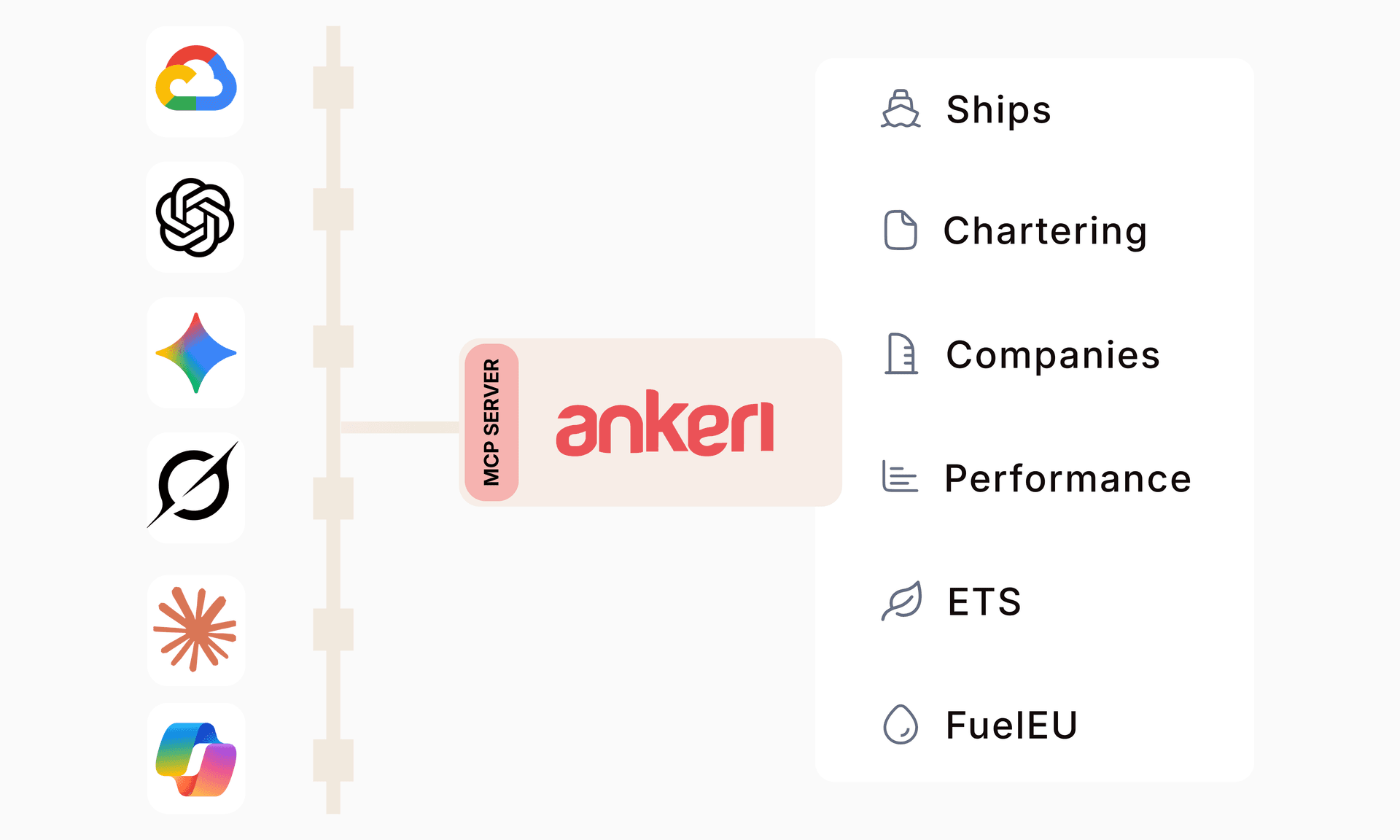
Ankeri’s MCP servers provide a secure, standardized interface for AI systems to interact with operational data.
This allows:
- External AI tools to access structured maritime data safely, taking into account user rights
- Automation of reporting, audits, and compliance workflows
- Integration into customer-specific AI ecosystems
- Scalable AI adoption without compromising governance
In short, Ankeri becomes a platform for AI-driven Time Charter operations.
Security and Control by Design
AI adoption in shipping raises a critical question: who controls the data?
At Ankeri, the answer is simple, you do.
Both the AI Agent and MCP architecture are built on the same principles:
- Role-based access control is always enforced
- AI only accesses data users are authorized to see
- All interactions are auditable
- Sensitive data remains within controlled environments
The Future: AI-Native Maritime Operations
We believe the maritime industry is moving toward a model where:
- Operational data is conversational
- AI copilots are part of daily workflows
- Commercial and technical insights are continuously connected
- Decisions are made faster, with full context
In that future, Ankeri is the operational backbone that AI systems rely on.
At Ankeri, our mission has always been to turn complex maritime data into actionable insight, bridging the gap between technical and commercial teams.
With the introduction of the AI Agent and MCP, we are extending that mission.
AI will not replace expertise in shipping. But it can amplify it when connected to the right context.
That is what we are building at Ankeri.